Alex Tuppurainen and Edmond Yang · September 2026
A comparative analysis of Canadian, American, and Finnish approaches to plurilingual education and what North American systems can learn from Finland.
Introduction
English-dominant educational frameworks remain influential in the United States and Canada, although the degree to which multilingualism is incorporated varies across jurisdictions. However, in practice this method has disconnected students and distorted their “familiarity with what was considered normal” (Linares, 2024, p. 35). As plurilingual students in a monoglossic education, we strive to find the basis of plurilingual structure and how a rework can be implemented to support diversity.
The Finnish framework examined in this study conceptualizes multilingualism not simply as a language-learning model, but as an integral part of learning, identity, interaction, and social participation (Inha, n.d, p.1; Zilliacus et al., 2023, p. 162). In contrast, although Canada’s language system is officially bilingual and often presented as inclusive, it continues to reflect colonial language hierarchies within schools, focusing on either English or French (Sterzuk & Shin, 2019, p. 61).
We combined academic scholarship, official educational policy documents, and statistical evidence from Canada and the United States for our corpus because both education systems share similarities through language in education. Uniting the two countries highlights the pattern within North America while allowing us to focus on them individually. Though Finland poses a successful and world renowned education model, a transfer of systems raises challenges due to differences in cultural values and colonial roots between these countries. Our corpus includes Ministry of Education documents and academic works by North American and European scholars. Through this discourse analysis, we will examine how both systems view multilingual education and what values or assumptions these perspectives reveal.
While past studies identify the restraints of monolingual education, there is a lack of consideration of comparing different education systems, especially those that have successfully established plurilingual frameworks. Understanding how multilingual models function in other countries will reveal strategies for transforming the dominant North American frameworks represented in this corpus. This gap leads us to ask: How can North American education (Canada and the United States) benefit from plurilingual pedagogies inspired by Finnish approaches?
By comparing Canadian and American approaches with Finland’s plurilingual framework, this paper argues that education can better support linguistic equity and cultural inclusivity when language is treated not merely as a skill to be acquired, but as a resource for learning, communication, identity, and participation.
This paper will first review the corpus construction and methodology strategies utilized in analyzing the articles and sources that manufactured our research. We will then present our results and discussion that integrate excerpts from our corpus to highlight patterns within our respective regions, and discuss the key takeaways from them. Finally, we will conclude our findings and reflect on the implications that can be taken on Canadian and American educational frameworks, followed by the full set of references and appendices used for our research.
Methodology
Our initial interest in this topic emerged from discussions on the paper Pluralingualism and Multimodality: The Metanoia Within Reach (Werner, R. and Todeva, E., 2022), which prompted us to reflect on our experiences within Vancouver’s educational context and consider how Canadian approaches compare with other educational systems. These discussions motivated our investigation of plurilingual pedagogy and language ideology.
Our personal links to the thesis of these articles has served as the motive of our research. Utilizing this, we identified two North American studies, English Monolingualism in Canada: A Critical Analysis of Language Ideologies (Sterzuk and Shin, 2021) and Call It What It Is: Monolingual Education in U.S. Schools (Hinton, 2016). In both papers, each author demonstrates the inadequacy of their respective countries’ monolingual education in our diverse world and their call for action. We also incorporated statistical evidence of the Education Quality and Accountability Office (EQAO) regarding multilingual and monolingual student achievement in Ontario.
In contrast, we decided that Finland is a good example of plurilingual education, as its national educational framework explicitly incorporates language awareness, multilingualism, and language development across the curriculum. For the corpus, we went to the European Center for Modern Education to find articles from Finland and its curricula. To diversify our argument we were able to find an article titled Students’ Orientations Towards Multilingualism . . . in Finland (Zilliacus, Holm, & Wallinheimo, 2023) which highlights student voices on protecting language spaces and embracing multilingual practices within educational programs.
In all, our corpus utilizes both articles and statistics to shed light on the importance of plurilingualism and the opportunity it gives to students, allowing us to create a paper with the topic around how North America can adopt plurilingual education incorporated from other countries’ education systems.
Our research investigates how North American education systems could integrate plurilingual and multimodal pedagogies, inspired by theoretical frameworks discussed by Werner & Todeva (2022) and Linares (2024). Plurilingualism is the ability to dynamically use multiple languages and cultural knowledge in an interconnected way. Drawing from these authors’ concepts of translanguaging and plurilingualism as “new” educational practices, we developed a corpus to examine how and why monolingual models should incorporate other nations’ plurilingual practices (e.g. Finland).
Our corpus consists of academic articles, official educational policy documents, and statistical evidence concerning language education in North America and Finland. The policy documents provide institutional perspectives from British Columbia, Ontario, and New York, while the academic sources provide critical perspectives on language ideology, monolingualism, plurilingualism, and translanguaging. Following Smagorinsky (2008), we identified recurring themes and arguments that assisted in reducing our dataset. We condensed our data by separating our sources into their respective domains, focusing on contrasting approaches to language education and the ways multilingual learners and linguistic resources are positioned within educational systems. We continued by removing general background sections and focusing on excerpts that explicitly reference pedagogical methods, language policy, or student perspectives. This reduction allowed for a focused comparative analysis between North American and Finnish educational models.
We employed colour-coding to identify recurring and new discourse features such as language inclusivity, policy, education, and perspectives. Each code has a theoretical construct derived from Werner & Todeva’s (2022) “metanoia”, defined as a reorientation towards embracing plurilingualism and educational transformation through multilingual engagement. While reading we emphasized the linguistic models, hierarchy, and cultural framing of language practices; we tagged them to reveal ideological contrasts between North American and Finnish contexts/models. We then compared the coded excerpts to identify recurring differences in how languages were positioned: targets of proficiency, resources for learning, components of identity, or institutional support.
Results and Discussion
Consider this excerpt (1) from Hinton (2016) discussing the logic of monolingualism:
If normal is defined as majority, the U.S. fixation on monolingualism is not normal. If normal is defined as an ideal, mounting evidence suggests that instruction in only one language falls far short of ideal. (Hinton, 2016, p.30)
Hinton disrupts the idea that monolingualism is normal. By redefining normal both quantitatively (majority) and qualitatively (ideal), he exposes that monolingual educational systems are in fact abnormal compared to the global linguistics norms. This quote supports the idea that monolingual education is in no way normal nor is it beneficial for its demographic, serving as a motive for its change.
Follow this example (2) from Sterzuk & Shin (2019) describing Canada’s hypocrisy in language policies:
The ideology of bilingualism in Canada needs to be situated within the social, political, and economic context of contemporary colonialism and capitalism. Within this context, some linguistic and cultural differences are constantly constructed as deficit despite the widespread celebration of diversity at the discourse level in educational institutions. (Sterzuk & Shin, 2019, p.61)
This excerpt displays Canada’s official bilingualism (often seen as progressive) still holds colonial frameworks that reinforce a language hierarchy that devalue non-dominant languages and diversity. The contrast between public celebration of diversity and the institutional exclusion fortify the persistence of this dominant language system. Sterzuk & Shin (2019) call out Canada’s hypocrisy of promoting their inclusive society when its structure is one that excludes, which vocalizes the need for multilingualism in its core.
Review this instance (3) where Hinton (2016) highlights the significance of multilingual education:
Yet all of that is largely academic. In our multilingual world, Spanish, Chinese, and other languages will not be easily dismissed. Regardless of the field—linguistics, economics, business, education, literature, neurology, sociology, politics, or public policy—language knowledge is leveraged to gain economic and social benefits. (Hinton, 2016, p.34-35)
Here, Hinton (2016) views multilingualism as an expression of human capital, referencing Bourdieu’s idea of the power of linguistics. He argues that though in academics language is considered a secondary asset, in the real world, language knowledge provides a valuable asset across many fields. This excerpt questions how our current monolingual education systems are failing to prepare its students for a multilingual global society, calling for a change in its system.
Examine this graph (4) that demonstrates the percentage of multilingual and monolingual (living in Canada for over 5 years) students who achieved Level 3 or 4 on primary and junior division writing assessment components in Ontario:
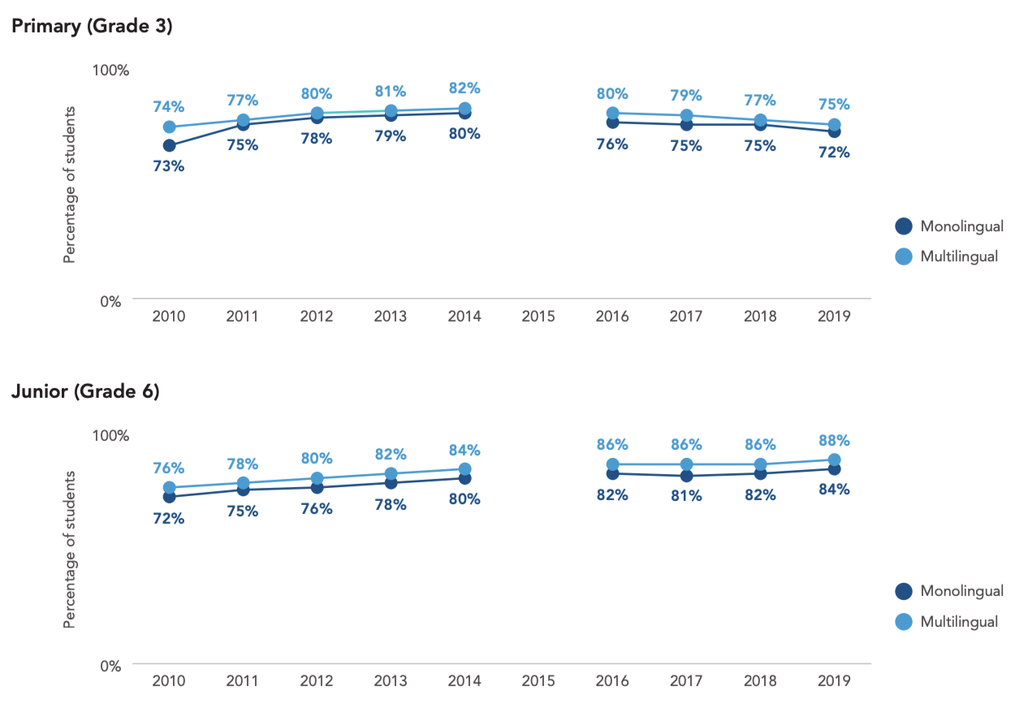
The graph shows that multilingual students achieved a higher grade in Level 3 or 4 results in both the primary and junior division writing assessments than monolingual students who had lived in Canada for more than five years. This finding challenges the assumption that multilingualism creates an academic disadvantage. Instead, the results suggest that multilingualism can coexist, and potentially support, academic performance. However, the data shows a link, not cause and effect, so we cannot conclude that multilingualism caused the difference in grade.
The academic critiques in the North American corpus are reinforced by examining the language used in official educational policy. British Columbia and Ontario provide particularly clear examples of how multilingual students are positioned within English-dominant school systems. The British Columbia Ministry of Education states that English Language Learning services assist students in becoming “proficient in the academic English” of B.C. schools and identifies “full integration into the mainstream school program” as an objective (British Columbia Ministry of Education and Child Care, 2026). Although the policy recognizes that students may require additional language support, its central objective remains proficiency in the language of instruction needed to access the provincial curriculum. The multilingual learner is therefore positioned primarily in relation to developing the dominant language of schooling.
Ontario policy presents a similar position. The Ontario Ministry of Education states that students in English-language schools must graduate with the ability to use English effectively for “thinking, learning and communicating” and requires schools to provide programs which help English language learners develop that proficiency in English (Ontario Ministry of Education, 2026). English is also required throughout the curriculum, with opportunities to use English skills across subject areas. This framing is significant because language support is organized primarily around developing proficiency in the language of instruction. Other languages may be recognized, but English remains the central institutional language through which students are expected to access and demonstrate learning.
The North American policy landscape is not, however, uniformly monolingual. New York State provides an important counterexample. The New York State Education Department explicitly uses the term “Multilingual Learner” and states that students’ education paths and social-emotional needs should be met “in multiple languages” (New York State Education Department, 2023). Its framework rejects the assumption that simply placing multilingual learners in an English-speaking environment will allow them to succeed academically. This represents a significant movement toward a multilingual educational model. New York therefore demonstrates that North American policy is changing, even while English proficiency remains an explicit educational objective.
The contrast with the Finnish framework is therefore not whether North American education permits languages other than English, but the degree to which multilingualism is integrated into the conception of learning itself. In the BC and Ontario policy documents examined here, additional language support is primarily connected to students’ ability to participate in an English-language curriculum. New York moves further toward recognizing multilingual resources within instruction. Finnish policy, however, places language awareness and multilingualism directly within the broad education system. The Finnish National Agency for Education describes the use of different languages in school as natural and states that language awareness is central to learning, interaction, cooperation, and identity. It also positions every teacher as a linguistic model and as a teacher of the language specific to their subject (Finnish National Agency for Education, 2026).
This difference is important because it shifts the role of language from an additional skill that students acquire to a resource through which learning takes place. Inha’s account of the Finnish curriculum similarly describes language education as multidisciplinary, while Piccardo defines plurilingual competence through the development of an individual’s entire linguistic and cultural repertoire. The Finnish framework therefore connects language learning with learning more broadly: students are not simply learning another language, but using their linguistic resources to access knowledge, communicate, develop identity, and participate in different areas of education.
The evidence consequently suggests that Finland offers a stronger model for learning through language than the dominant North American frameworks represented in this corpus. This does neither mean that English proficiency is unimportant, nor that North American education uniformly rejects multilingualism. Rather, the difference lies in the role assigned to students’ linguistic resources. The North American policies examined here vary from English-dominant models in British Columbia and Ontario to the more multilingual orientation visible in New York. Finnish policy goes further by making language awareness and multilingualism part of the educational environment itself. This provides a useful model for North American education to move from accommodating multilingual learners toward integrating their linguistic repertoires into teaching and learning.
Inha’s account of the Finnish National Core Curricula (5) defines the principle of language awareness that underpins language education across the curriculum:
Language awareness denotes placing value on linguistic and cultural diversity, seeing languages as a means of negotiating and mediating meaning, and understanding how languages are relevant for the development of multi-layered linguistic and cultural identities. (Inha, n.d., p. 2)
The rhetorical work of this passage lies in its verb. Inha writes that language awareness “denotes” a set of orientations, framing the concept as one already established in Finnish educational discourse rather than one requiring justification. The definitional register is significant: where advocacy presupposes resistance, definition presupposes consensus. The passage further declines to name any individual language. Its referents remain plural and unspecified, “linguistic and cultural diversity,” “languages,” “multi-layered linguistic and cultural identities”, and a framework that names no language cannot rank one above another. What the passage specifies instead are three dispositions, expressed in parallel participial clauses: placing value, seeing, and understanding. Language awareness is thus constituted as an orientation held by educators rather than a proficiency demonstrated by students. Equally telling is what the passage omits. It contains no proficiency threshold, no assessment criterion, no category of deficiency, and no designation comparable to the North American “English language learner.” The absence of remedial terminology in this passage contrasts with the intervention-oriented terminology found in the North American policy documents examined above.
Review this instance (6) where Piccardo (2019) argues for a metanoia from monolingual to plurilingual frameworks in language education:
Plurilingual competence is defined as the ability to use a plural repertoire of linguistic and cultural resources to meet communication needs or interact with people from other backgrounds and contexts, and enrich that repertoire while doing so. The repertoire consists of resources which individual learners have acquired in all the languages they know or have learned, and which also relate to the cultures associated with those languages . . . The plurilingual perspective centres on learners and the development of their individual plurilingual repertoire, and not each specific language to be learnt. (Piccardo, 2019, p. 5)
Piccardo’s vocabulary choices, such as “plural repertoire,” “resources,” “enrich,” “development,” and “not each specific language,” emphasize the flexible and evolving nature of plurilingual competence. The excerpt shifts the focus away from mastering individual languages toward learners’ ability to draw on their combined linguistic and cultural resources. This perspective provides a conceptual base for educational approaches that recognize partial and diverse linguistic competencies as resources rather than barriers.
Follow Zilliacus et al. (2023) (7) as they show how students at a Swedish-medium university in Finland recognize the relationship of multilingualism/plurilingualism and social justice. They (the students) uncover both inclusivity and tension in their discourses:
Instead of pointing to the potential difficulties in language practices in multilingual classrooms, this student presents language awareness as an essential competence for an educator. A competence that enables them to reflect on the linguistic power relations in the classroom and take them into account in their linguistic practices and communication. (Zilliacus, Holm, & Wallinheimo, 2023, p. 629)
This excerpt emphasizes language awareness as competence for educators in multilingual classrooms. The authors’ use of phrases such as “linguistic power relations”, “take them into account,” and “linguistic practices and communication” highlight the importance of recognizing how language can shape interactions within the classroom. Rather than presenting multilingualism simply as a challenge, the excerpt frames educators to be responsible for reflecting on linguistic relationships and incorporating this awareness into their teaching and communication practices. This creates a connection between language awareness and educators’ ability to respond thoughtfully to the complex multilingual pedagogy environments.
The following passage (8) from Inha’s work reveals how Finland’s educational philosophy integrates language instruction across all subject areas rather than confining it to designated language classes. It highlights a key principle: every teacher, regardless of their discipline, serves as both a linguistic model and a language educator within their specific domain:
In addition to a stimulating learning environment, as well as appropriate and contemporary pedagogical methods, the Finnish education system aims to provide pupils with skills and knowledge that foster language education. Languages and language education are multidisciplinary: Each teacher functions as a linguistic model as well as a teacher of the language specific to the subject in question. (Inha, (n.d.), p. 1)
What stands out in Inha’s writing is that she emphasizes multidisciplinarity. She also recognizes that language permits all learning experiences rather than language existing as an isolated skill. By positioning “each teacher” as “a linguistic model” Inha suggests that language development happens constantly throughout the school day. Students acquire the specialized discourse of mathematics, science, history, and other fields through authentic engagement with their teachers. Students aren’t just learning vocabulary and grammar in isolation but rather developing the specific language registers necessary for different domains of knowledge. The phrase “foster language education” suggests nurturing and organic growth rather than rigid pedagogy. This aligns with plurilingual approaches and context dependent language use across different learning contexts.
Conclusion
Our analysis of Canadian, American, and Finnish educational discourse reveals that multilingualism is conceptualized differently across educational systems. British Columbia and Ontario policy documents demonstrate that English proficiency remains a central institutional objective, with multilingual learners frequently positioned in relation to the dominant language of instruction and the need to access the existing curriculum. New York provides evidence of a developing alternative within North America, where multilingual learners, home languages, and multilingual development are more explicitly incorporated into educational policy. The North American context is therefore not uniformly monolingual, but it remains uneven in its movement toward plurilingual education.
In contrast, the Finnish discourse examined in this research places plurilingualism closer to the centre of pedagogy. Inha frames language education as multidisciplinary and assigns every teacher a role as a linguistic model, while Piccardo conceptualizes competence through the development of an individual plurilingual repertoire. Zilliacus et al. further connect language awareness with educators’ responsibility to recognize linguistic relationships and power within multilingual classrooms. Together, these sources present language not simply as a skill students must acquire in order to access education, but as part of how students learn, communicate, construct identity, and participate in educational spaces. This makes the Finnish framework particularly valuable as a model for rethinking North American language education.
The evidence therefore supports a shift in North American education from accommodation-based approaches toward more integrated plurilingual pedagogies. Rather than replacing English instruction or ignoring the importance of proficiency in the dominant language, a plurilingual framework would recognize students’ existing languages as resources for acquiring new knowledge and developing additional languages. Finland offers a particularly strong example of how language learning can be integrated across the curriculum rather than in isolation with language-specific instruction. While Finnish practices cannot be transferred directly because of differences in historical, cultural, and political contexts, their underlying principles of linguistic equity, multilingual identity, and language-aware teaching provide useful guidance for North American pedagogy transformation.
References
American Psychological Association. (2020, October 21). Student Paper Setup Guide – APA style. Student Paper Setup Guide. https://apastyle.apa.org/instructional-aids/student-paper-setup-guide.pdf
British Columbia Ministry of Education and Child Care. (2026). English language learning students. Government of British Columbia. https://www2.gov.bc.ca/gov/content/education-training/k-12/administration/legislation-policy/public-schools/english-language-learning
British Columbia Ministry of Education and Child Care. (2025). Language education policy. Government of British Columbia. https://www2.gov.bc.ca/gov/content/education-training/k-12/administration/legislation-policy/public-schools/language-education-policy
New York State Education Department. (2023). Blueprint for English language learner/multilingual learner success. Office of Bilingual Education and World Languages. https://www.nysed.gov/bilingual-ed/english-language-learner-and-multilingual-learner-educator-tools-and-best-practices
Ontario Ministry of Education. (2026). Ontario schools, kindergarten to grade 12: Policy and program requirements. Government of Ontario. https://www.ontario.ca/document/ontario-schools-kindergarten-grade-12-policy-and-program-requirements
Linares, R. (2024). Resisting monoglossic ideologies: Translanguaging as the (he)art of language arts. English Journal, 114(1), 34-43. Retrieved from https://www.proquest.com/scholarly-journals/resisting-monoglossic-ideologies-translanguaging/docview/3134904312/se-2
Smagorinsky, P. (2008). The Method Section as Conceptual Epicenter in Constructing Social Science Research Reports. Written Communication. https://journals.sagepub.com/doi/10.1177/0741088308317815
Werner, R., & Todeva, E. (2022). View of plurilingualism and multimodality: The Metanoia within reach. Plurilingualism and Multimodality: The Metanoia Within Reach. https://teslcanadajournal.ca/index.php/tesl/article/view/1487/1325
Appendix A Corpus Materials
British Columbia Ministry of Education and Child Care. (2026). English language learning students. Government of British Columbia. https://www2.gov.bc.ca/gov/content/education-training/k-12/administration/legislation-policy/public-schools/english-language-learning
British Columbia Ministry of Education and Child Care. (2025). Language education policy. Government of British Columbia. https://www2.gov.bc.ca/gov/content/education-training/k-12/administration/legislation-policy/public-schools/language-education-policy
Education Quality and Accountability Office. (2024, June). Multilingual Student Achievement in Ontario’s English-Language Board. Eqao Home Page. https://www.eqao.com/multilingual_student_achievement_research_brief/
Hinton, K. A. (2016, March 9). Call It What It Is: Monolingual Education in U.S. Schools. https://www.tandfonline.com/doi/full/10.1080/15427587.2015.1124021#d1e125
Inha, K. (n.d.). Language education in the Finnish National Core Curricula. https://www.ecml.at/Portals/1/gazette/Gazette%2044/Finland_Language%20education%20in%20Finland.pdf
Piccardo, E. (2019). We are all (potential) plurilinguals”:Plurilingualism as an overarching, holistic concept. View of “We are all (potential) plurilinguals”: Plurilingualism as an overarching, holistic concept. https://uottawa.scholarsportal.info/ottawa/index.php/ILOB-OLBI/article/view/3825/3781
Sterzuk, A., & Shin, H. (2019, January 1). English monolingualism in Canada: A critical analysis of language ideologies. SpringerLink. https://link.springer.com/chapter/10.1007/978-3-030-56654-8_4
Zilliacus, H., Holm, G., & Wallinheimo, K. (2023). Students’ Orientations Towards Multilingualism and Social Justice in a Swedish-medium University Degree Program in EducationalSciences in Finland. https://www.tandfonline.com/doi/epdf/10.1080/15348458.2021.1938574?needAccess=true