Alex Tuppurainen · October 2026 · Working Paper, Version 2.1
Abstract
This paper examines whether organizations can scale sustainably through increasing managerial effort or whether sustainable scale requires systems that reduce recurring overhead. The Systems / Hustle framework proposes that effective, repeatable methods reduce dependence on compensating effort, improving scalability, efficiency, and leverage.
The framework distinguishes peak productive hustle from Hmax, a later threshold of maximum sustainable workload, and examines how managerial overload reduces the capacity to develop better systems. The Extended Model introduces signal versus noise, proposing that organizational adaptability depends on both operational capacity and the ability to respond to consequential environmental information.
Research Question
Can organizations scale sustainably by increasing managerial effort, or does sustainable scale require systems that reduce overhead?
Origin of the Hypothesis
The observations underlying this research began during my time as a co-founder and Chief Operating Officer of LintelAI Technologies Inc. At the time, I had not put the words “systems” and “hustle” together. I was primarily trying to keep the organization moving. Looking back, however, LintelAI became the place where I first experienced the tension between producing outcomes through continuous individual effort and producing outcomes through structured systems.
LintelAI had a team of fifteen people across different cities and time zones in North America. Although we had defined roles, communication infrastructure, task-management tools, and recurring meetings, much of the organization still depended on manual coordination. I spent significant time messaging people individually, chasing updates, checking work, enforcing deadlines and quality, reassigning tasks, organizing meetings, and coordinating around different schedules and time zones. The majority of the problems were not new, they were recurring patterns: poor communication, missed deadlines, unclear understanding of what others were working on, and people working on anything but their priorities.
The four co-founders formally defined responsibilities in writing, yet the fact that we were all co-founders made the boundaries psychologically weak. Each person had views about how parts of the company should operate. This made decisions easily turn into lengthy discussions. In many cases, the problem was not a lack of intelligence or effort. It was that the organization depended too heavily on people continuously negotiating, clarifying, and coordinating with one another.
One of the strongest improvements came from introducing a monthly commitment structure for the founders. At the beginning of each month, I made each founder define their area of ownership, measurable outcomes, weekly deliverables, decision rights, required resources, and an escalation path. This decreased co-founder interference, friction, deadlines were met more consistently, and it became difficult to renegotiate previously promised priorities. As this structure began working, we were able to reduce the number of meetings required not just with the co-founders but also across the whole organization. What happened was that people had not fundamentally changed, but the method through which their work was coordinated changed for the better.
At the same time, the development side demonstrated problems. Our CTO was an exceptionally capable in computer science and machine-learning, but his preference was often to complete important work himself (confidence in quality). He delegated tasks, but cautiously, and frequently he carried more technical work personally than was scalable. Meanwhile, partnerships and customer demand continued progressing. We had thousands of units associated with prospective clients and an organic client opportunity worth approximately $15,000 in MRR, while the product itself was still not ready for deployment.
The issue was not simply that the CTO needed to work harder. He was already working extremely hard. Commercial demand was moving faster than technical output, and adding additional effort/people eventually began going in the opposite direction of intended results. As cognitive load increased, switching between deliverables became increasingly difficult, deadlines became less predictable, and the technical bottleneck slowed the whole organization. This experience later became one of the clearest foundations for what I describe in this research as Hmax: the point at which an individual remains technically functional but is carrying so much cognitive load that the workload itself begins to hinder performance.
My own experience as COO uncovered a related problem. I was frequently solving recurring internal problems as though they were isolated fires. The more time I spent keeping the organization functioning, the less time I had for necessary work to improve how the organization functioned (working in the company V.S. working on the company). Process design, partnerships, sales, customer acquisition, and product rollout competed with immediate coordination problems.
I later came to think of this using an automotive analogy: trying to improve the engine while the rest of the car is constantly breaking. If you stop repairing the car and focus on the engine, there eventually may not be any car left for the engine.
The core model became clearer during the summer of 2026 while I was travelling through Mainland China and Hong Kong. What stood out to me was the scale at which activity, particularly information, capital, and logistics were coordinated through repeatable systems without needing a proportional increase in direct individual management. I began connecting those observations to what I had experienced at LintelAI. The question became less about whether people were working hard and more about how their effort was being converted into organizational output.
That comparison also made me consider organizations I had experienced before LintelAI. The strongest example is the Royal Canadian Sea Cadets. The cadets operate much of the organization themselves: meetings, sailing activities, lessons, workshops, presentations, problem-solving, and many aspects of personnel leadership. Officers provide the broader legal, safety, and organizational framework.
The effectiveness of this structure comes from more than written procedures. Cadets are trained into the system over years. Standardized terminology, rank structures, recurring operating formats, defined authority, institutional knowledge, and repeated leadership experience are embedded in how everyone operates. A senior cadet responsible for an activity may become unavailable, but that activity will continue because other cadets understand the structure. Cadets can move between units and elements with low adaptation because the functioning system remains the same. The system makes supervision predictable and scalable, as well as develops the people who operate in it.
This created an important contrast. At LintelAI, capable individuals were frequently compensating for weak systems through additional effort. In Cadets, the system helped create capable individuals and then allowed their effort to scale beyond any single person.
From these experiences, I began to form a broader definition of a system: the chosen method by which an organization repeatedly converts inputs into outcomes. The method does not have to be software, automation, bureaucracy, or rigid procedure. The appropriate system depends on the work being performed, the people performing it, and the consequences of failure. A startup, a fire department, a military unit, and a national logistics network may operate through radically different structures while still coming across the same underlying management problem.
Hustle, in contrast, can be understood as direct effort used to create progress where no repeatable method yet exists. Hustle is therefore not inherently inefficient or undesirable. In uncertain environments it may be the fastest way to discover what works. The problem appears when recurring work continues to depend on increasing amounts of direct effort even after patterns have become visible.
This led to the core behind my Systems / Hustle framework. Hustle can increase output up to a point, but after the point of maximum productive effort, additional workload begins to reduce performance. The individual may continue operating for some time, though at a increasing cognitive load, declining effectiveness, and less capacity to step back and build the systems required for further growth. Hmax describes the later stage of this decline, where the individual is still functioning but badly overloaded.
The managerial challenge is therefore not simply to replace hustle with systems. It is to recognize when hustle has revealed a repeatable pattern and to convert that pattern into a method that can support scale. If that transition happens too early, useful momentum may be lost, but if it happens too late, the people responsible for building the system may already be too overloaded to build it effectively (automotive analogy).
The hypothesis emerged from that tension: hustle creates progress where the path is not yet known; systems convert learned methods into scalable capacity. The balance between the two is not fixed, and the appropriate system differs across organizations. The underlying management problem, however, remains the same: how to continue increasing organizational output without requiring proportional increases in direct individual intervention.
Core Model
The initial model I made in Hong Kong for this research is simple: systems do not necessarily reduce human involvement; they reduce the amount of unstructured effort required to produce a repeatable outcome.
The model
System: A system is the chosen method by which an organization repeatedly converts inputs into outcomes.
Hustle: Direct effort used to create progress when an effective, repeatable method is absent or insufficient.
The Relationship: A weak system requires more compensating effort:
A stronger system reduces the amount of hustle required to achieve the same outcome:
That reduction comes through lower friction, overhead, and coordination burden.
Together:
The purpose of the model is not to argue that hustle should disappear. Hustle is often necessary when an organization is exploring, responding to uncertainty, or solving a new problem. The argument is that recurring outcomes should increasingly be supported by systems rather than repeated discretionary effort.
The core model explains the relationship between systems and hustle. It does not yet explain why organizations become dependent on hustle, how managers process information, or how external changes affect the system. Those questions require a broader model of how organizations interact with their environment.
Extended Model
The core model proposes that stronger systems reduce an organization’s dependence on hustle, increasing scalability, efficiency, and leverage.
The extended model asks why that relationship exists.
An organization does not operate in isolation. It is continuously affected by forces outside its direct control: customers, competitors, technology, regulation, capital, labor, markets, suppliers, and broader changes in the environment.
Let
These external forces generate information and conditions that the organization must respond to:
where (I) represents incoming information.
The role of management, therefore, is not simply to “run the company day-to-day” in the conventional way. While managers cannot fully control the external environment, they can design and maintain the systems through which environmental information is received, interpreted, and converted into decisions, actions, and ultimately organizational outcomes.
The basic process can be represented as:
In this model, management is partly the design and maintenance of the architecture through which external inputs become action in the organization.
This distinction matters because the same external environment can produce very different outcomes depending on how the organization processes it.
In a highly manager-dependent organization, the process may resemble:
Information travels upward, the manager interprets it, a decision is made, and instructions travel back through the organization.
This can work at small scale. However, as the volume and complexity of information increase, more decisions, exceptions, questions, and coordination requirements begin to accumulate around the manager.
The organization increasingly depends on direct managerial effort to continue functioning.
A stronger system changes the structure:
The system may still be entirely operated by people. The distinction is not between humans and automation. It is between work that occurs through a chosen, repeatable method and work that depends on repeated discretionary effort.
This connects directly to the core model:
When recurring situations lack an effective system, people must compensate. They follow up manually, reinterpret the same problems, coordinate repeatedly, resolve ambiguity, remember exceptions, and push work forward through direct effort.
This compensating effort represents hustle: direct intervention required when an effective, repeatable method is absent or insufficient.
Therefore:
whereas:
for a given level of organizational output.
The problem becomes more significant as an organization grows.
Suppose the volume and complexity of work requiring organizational response is represented by (C_e). However, not all organizational complexity requires direct managerial intervention. Let (D_m) represent the resulting demand placed on an individual manager, while (C_m) represents the amount of managerial work that individual can sustainably process over the same period.
As the organization grows:
while an individual manager’s capacity remains bounded:
In a sufficiently manager-dependent organization, growing organizational complexity can eventually cause managerial processing demand to exceed sustainable individual capacity:
The gap must then be absorbed somewhere.
One response is additional hustle.
The manager works longer, attends more meetings, answers more questions, follows up more frequently, handles more exceptions, and makes more decisions personally.
Thus:
can temporarily compensate for insufficient system capacity.
However, increasing managerial effort has limits. As hustle increases, performance may initially improve until reaching an apex of maximum productive effort.
Reaching the apex of maximum productive hustle does not mean an individual has reached the limit of their working capacity. Beyond this point, managers may continue taking on additional responsibilities and increasing their effort, even as their overall performance declines. As cognitive overload, stress, and competing demands accumulate, the individual moves further along the declining side of the performance curve. Eventually, they approach a second threshold, which this model defines as:
This represents the maximum sustainable level of hustle before severe overload. Unlike the apex, which represents maximum productive performance, Hmax represents the limit of sustainable workload, reached after performance has already begun to deteriorate.
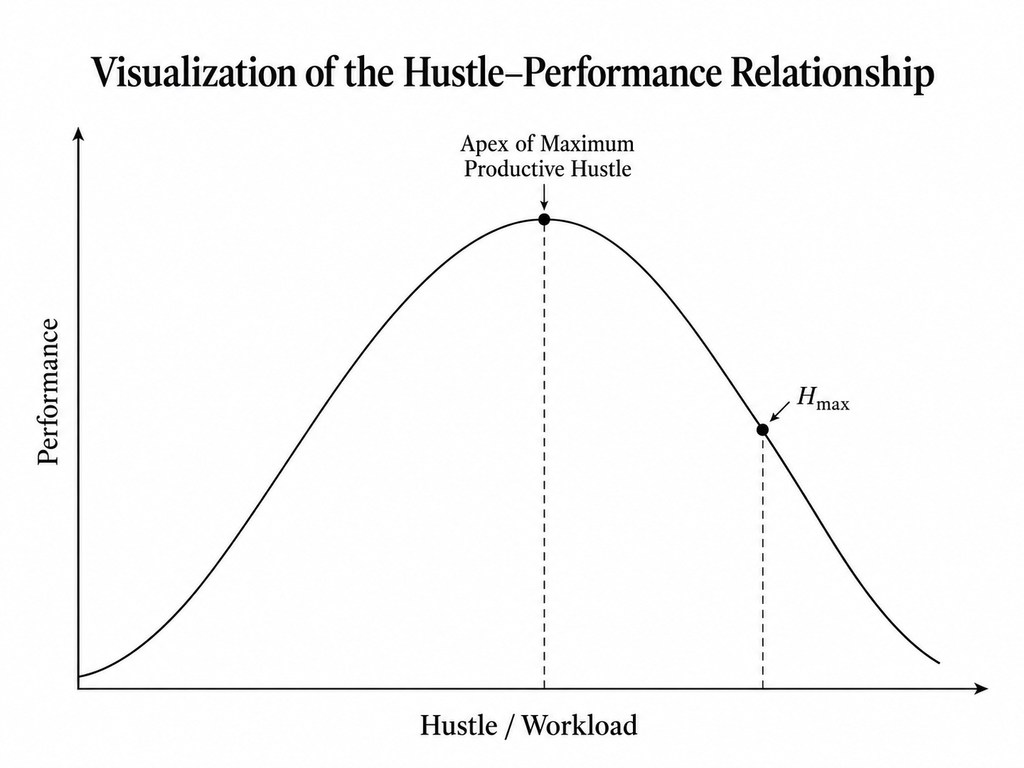
Figure 1. Systems / Hustle conceptual performance curve illustrating peak productive hustle and declining performance before H-max.
As required hustle approaches that limit,
the organization becomes increasingly vulnerable to bottlenecks, delays, errors, declining decision quality, and reduced capacity for improvement.
The scaling problem is therefore not solved simply by asking managers to process more.
It requires increasing the organization’s ability to process recurring complexity through systems:
Note: as managers approach Hmax the harder it becomes to build necessary systems.
Effective systems reduce the hustle required to produce recurring outcomes, allowing organizations to manage greater complexity without proportional increases in managerial effort.
However, increasing an organization’s capacity to process information is inadequate if its systems cannot distinguish between information that matters and information that does not.
Not all incoming information is equally important. Some represents meaningful change in customers, technology, markets, competition, regulation, or other conditions. Other information is irrelevant, misleading, temporary, or distracting.
This introduces a second relationship:
where signal represents information that is consequential to the organization and noise represents information that consumes attention without meaningfully improving its response.
A strong organizational system must therefore do more than process information efficiently. It must also accurately identify consequential information while filtering out irrelevant or misleading inputs.
The problem can occur in two directions:
The first causes the organization to ignore consequential change. The second causes it to spend resources reacting to information that does not warrant action.
This connects closely with Clayton Christensen’s work in The Innovator’s Dilemma, which demonstrates how established organizations can follow effective management practices while overlooking or deprioritizing disruptive opportunities that fall outside their existing value networks.
Christensen’s concept of the value network is particularly relevant because it describes the context within which firms identify and respond to customer needs, competitors, inputs, and opportunities.
From the perspective of this model, the problem is not necessarily managerial incompetence.
The organization may possess an effective system for processing information while still possessing the wrong system for the environment it now faces.
A system can therefore be highly efficient and still produce failure.
This suggests that organizational adaptability depends on two distinct but related dimensions:
which represents operational leverage: the extent to which effective systems reduce dependence on compensating hustle to produce recurring outcomes,
which represents information relevance: the relationship between consequential and irrelevant information reaching organizational decision-making.
Managers cannot fully control the environment in which an organization operates, but they can shape how it responds. Effective management therefore extends beyond personally resolving problems to designing and maintaining systems that identify consequential information and convert it into execution.
Organizational Adaptability
The combined model describes organizational adaptability: an organization’s ability to recognize consequential changes in its environment and translate them into appropriate decisions and actions through its existing or evolving systems.
The model therefore contains two distinct components:
Represents operational leverage: the extent to which the organization can produce repeatable outcomes without relying on increasing levels of compensating effort.
Represents information relevance: the relationship between consequential information and irrelevant or misleading information influencing organizational decisions.
Together:
This equation is a conceptual hypothesis suggesting that adaptability depends on operational leverage and information relevance, rather than an empirically established mathematical relationship.
An organization can therefore be operationally efficient while still being poorly adapted to its environment. Strong systems may allow it to execute consistently, but if those systems fail to identify important changes in customers, technology, markets, regulation, or competition, the organization can become highly efficient at responding to the wrong signals.
Conversely, an organization may correctly identify an important change in its environment but lack the systems required to respond effectively without substantial hustle.
The extended model therefore proposes that adaptability requires both: the ability to recognize what matters and the organizational capacity to respond to it through effective systems.
Literature and Intellectual Context
The Systems / Hustle framework originated from personal experience and observations, but many of its underlying ideas connect with established management research. This section explores those connections, examining how existing theories support, challenge, or expand upon the framework.
Herbert Simon, Bounded Rationality
Herbert A. Simon’s Administrative Behavior (1947) challenged traditional assumptions about rational decision-making in organizations. Simon argues that individuals operate with limited information and cognitive capacity, making perfectly rational decisions unrealistic. His work established the foundations of bounded rationality, emphasizing how organizational structures, communication, and distributed decision-making help individuals operate within these limitations.
This connects directly to the Systems / Hustle model’s distinction between managerial processing demand D_m and sustainable managerial capacity C_m. Effective systems can reduce this dependency by structuring recurring decisions and distributing responsibility across the organization.
Jay Galbraith, Organizational Information Processing
Jay Galbraith’s Organization Design: An Information Processing View (1974) argues that greater task uncertainty increases the amount of information organizations must process to maintain performance. Galbraith identifies two broad responses: reducing the need to process information or increasing the organization’s capacity to process it. These approaches include standardized procedures, clearer responsibilities, information systems, and coordination across organizational units.
This closely relates to the Systems / Hustle framework. Both recognize that growing complexity can overwhelm existing organizational structures. However, Systems / Hustle extends this relationship by examining how individuals compensate for insufficient organizational capacity through additional effort, and why that compensation becomes unsustainable as managerial workload approaches its limits.
Nelson, Winter & March, Organizational Routines and Learning
Richard Nelson and Sidney Winter’s An Evolutionary Theory of Economic Change (1982) describes organizational routines as repositories of institutional knowledge and capabilities. These routines allow organizations to reproduce established patterns of activity without continuously redefining how work should be performed. This closely aligns with the Systems / Hustle framework’s argument that repeated individual effort can be converted into organizational capacity through effective systems.
James March’s Exploration and Exploitation in Organizational Learning (1991) introduces a related distinction between exploring new possibilities and exploiting existing knowledge. This supports an important qualification to the Systems / Hustle framework: organizations must develop repeatable systems without losing the ability to experiment, learn, and adapt. Hustle may contribute to discovering new methods, while systems help organizations apply what they have learned consistently.
Clayton Christensen, Disruptive Innovation
Clayton Christensen’s The Innovator’s Dilemma (1997) examines why successful organizations can fail despite following effective management practices. Christensen argues that established firms often prioritize existing customers and profitable markets, making emerging disruptive opportunities appear unattractive. Their established processes and resource allocation systems can reinforce these priorities, limiting their ability to respond to changing market conditions.
This connects directly to the Systems / Hustle framework’s distinction between operational leverage and information relevance. An organization may possess highly efficient systems yet fail to adapt if those systems consistently deprioritize consequential changes in its environment. Christensen’s work therefore reinforces the argument that organizational effectiveness depends not only on how efficiently systems operate, but also on whether they direct attention and resources toward the right opportunities.
Cognitive Workload and Human Performance
G. Robert Hockey’s Compensatory Control model (1997) explains how individuals can maintain performance under high workloads by increasing their cognitive effort, often at the expense of greater fatigue, stress, and reduced capacity for secondary tasks. Research by van der Linden, Frese, and Meijman (2003) further demonstrated that mental fatigue can impair cognitive flexibility and planning, even when simpler cognitive functions remain relatively unaffected.
These findings support the Systems / Hustle framework’s distinction between productive effort and sustainable workload. Individuals may continue functioning under increasing demands while their cognitive effectiveness deteriorates. The framework extends this research into organizational management through Hmax, proposing that sustained overload not only undermine an individual’s performance but also reduces the managerial capacity available to develop systems that would alleviate the workload.
Working Propositions
P1 · Operational Leverage
Effective systems reduce the compensating managerial effort required to produce recurring outcomes, allowing organizations to scale without proportional increases in direct intervention.
P2 · Managerial Capacity
As managerial workload exceeds peak productive hustle and approaches Hmax, declining performance and increasing cognitive demands reduce the capacity available to develop systems that could alleviate the workload.
P3 · Organizational Adaptability
Sustainable organizational adaptability requires both effective systems and the ability to identify consequential environmental information. Operational efficiency alone does not guarantee an appropriate response to changing conditions.
These propositions remain conceptual hypotheses requiring examination through empirical evidence and organizational observation.
Counterarguments and Failure Cases
Over-Systemization
More systems do not necessarily produce better outcomes. Excessive procedures, bureaucracy, and rigid decision structures can create additional overhead and reduce organizational flexibility. Systems must fit the work being performed and the people operating them.
When Hustle Is Necessary
Not all organizational problems can or should be systemized. In unfamiliar, rapidly changing, or unpredictable situations, direct individual effort may be more effective than established procedures. Premature systemization risks institutionalizing methods before the organization understands what works.
Efficient Systems Can Still Fail
Organizations may develop highly efficient systems that become ineffective as external conditions change. A system optimized for existing customers, markets, or operations may overlook emerging opportunities and threats.
Limitations of the Mathematical Model
The relationships proposed in Systems / Hustle are conceptual rather than empirically established. Systems, hustle, information relevance, and organizational adaptability are difficult to measure consistently across different organizations. Individual capacity limits, including Hmax, also vary by person and circumstance. The mathematical relationships should be treated as hypotheses requiring further testing, not universal laws.
These limitations suggest that the objective is not to maximize systems or eliminate hustle, but to develop an appropriate balance that supports organizational performance under changing conditions.
Current Conclusions
The Systems / Hustle framework suggests that increasing managerial effort can sustain organizational progress, but cannot indefinitely compensate for insufficient systems. Sustainable scale depends on converting recurring effort into repeatable organizational capacity, allowing output and complexity to increase without proportional increases in direct managerial intervention.
The Extended Model further suggests that effective systems alone are insufficient. Organizations must also recognize consequential changes in their environment and respond appropriately. Sustainable adaptability therefore requires both operational capacity and the ability to identify what matters.
These conclusions remain provisional. While the framework is informed by organizational experience and existing research, its proposed relationships, including Hmax and the organizational adaptability equation, have yet to be tested through systematic organizational research.
Future research will examine these relationships through interviews, organizational observations, and case studies, with particular attention to when organizations should transition from reliance on hustle toward stronger systems.
References
Christensen, C. M. (1997). The innovator’s dilemma: When new technologies cause great firms to fail. Harvard Business School Press.
Galbraith, J. R. (1974). Organization design: An information processing view. Interfaces, 4(3), 28-36. https://doi.org/10.1287/inte.4.3.28
Hockey, G. R. J. (1997). Compensatory control in the regulation of human performance under stress and high workload: A cognitive-energetical framework. Biological Psychology, 45(1–3), 73-93. https://doi.org/10.1016/S0301-0511(96)05223-4
March, J. G. (1991). Exploration and exploitation in organizational learning. Organization Science, 2(1), 71-87. https://doi.org/10.1287/orsc.2.1.71
Nelson, R. R., & Winter, S. G. (1982). An evolutionary theory of economic change. Belknap Press of Harvard University Press.
Simon, H. A. (1947). Administrative behavior: A study of decision-making processes in administrative organization. Macmillan.
van der Linden, D., Frese, M., & Meijman, T. F. (2003). Mental fatigue and the control of cognitive processes: Effects on perseveration and planning. Acta Psychologica, 113(1), 45-65. https://doi.org/10.1016/S0001-6918(02)00150-6
ORCID: 0009-0003-7992-3747